Python Roadmap for AI/ML Beginners in 2026
The exact Python topics you need to learn for AI and Machine Learning — with a clear timeline and resources for students and beginners.

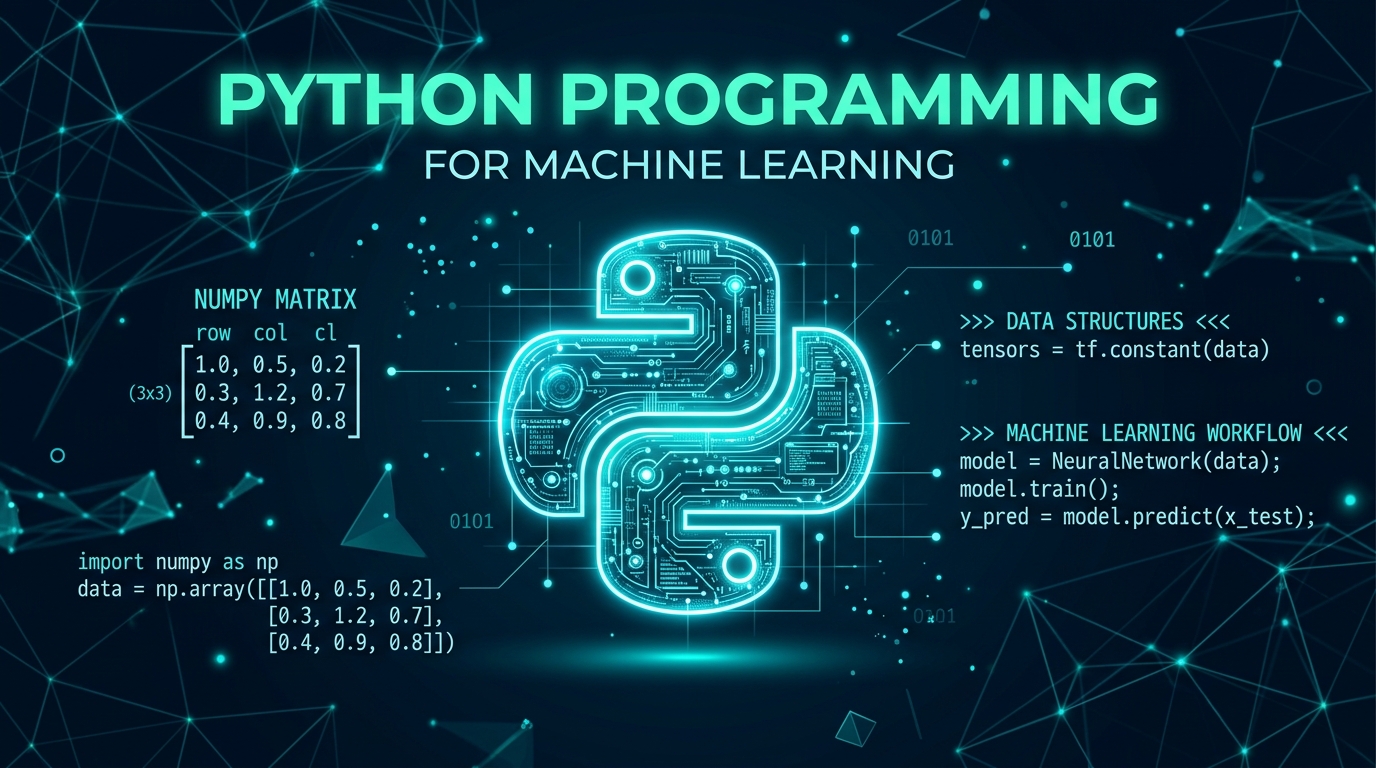
Table of Contents
Python is the language of AI. Every major ML framework — TensorFlow, PyTorch, scikit-learn, Hugging Face — is Python-first.
But Python is also a general-purpose language with a lot of features. If you try to learn everything, you’ll spend months before writing your first ML model.
This roadmap is designed for people who want to learn exactly the Python you need for AI and ML — nothing more, nothing less.
Stage 1: Python Fundamentals (Weeks 1–3)
These are non-negotiable. Master these before touching ML.
Variables and Data Types
# Basic types
name = "AI Career Lab"      # string
age = 22                    # integer
gpa = 8.5                   # float
is_student = True           # boolean

# Type checking
print(type(name))           # <class 'str'>
print(type(age))            # <class 'int'>
Data Structures
# List — ordered, mutable
skills = ["Python", "NumPy", "Pandas", "scikit-learn"]
skills.append("TensorFlow")
print(skills[0])            # Python

# Dictionary — key-value pairs
student = {
    "name": "Rahul",
    "branch": "CSE",
    "year": 3
}
print(student["name"])      # Rahul

# Tuple — ordered, immutable
coordinates = (12.9716, 77.5946)  # Bangalore coordinates

# Set — unordered, unique elements
unique_tags = {"AI", "ML", "Python", "AI"}  # "AI" appears once
Functions
def calculate_accuracy(correct, total):
    """Calculate model accuracy as a percentage."""
    if total == 0:
        return 0
    return (correct / total) * 100

accuracy = calculate_accuracy(87, 100)
print(f"Model accuracy: {accuracy:.1f}%")  # Model accuracy: 87.0%
List Comprehensions (Very Common in ML Code)
# Traditional way
squares = []
for i in range(10):
    squares.append(i ** 2)

# List comprehension — much more common in ML code
squares = [i ** 2 for i in range(10)]

# Filter with condition
even_squares = [i ** 2 for i in range(10) if i % 2 == 0]
Stage 2: Intermediate Python (Weeks 4–5)
Working with Files and Data
import csv
import json

# Reading a CSV file
with open('data.csv', 'r') as f:
    reader = csv.DictReader(f)
    for row in reader:
        print(row)

# Reading JSON
with open('config.json', 'r') as f:
    config = json.load(f)
    print(config['model_name'])
Error Handling
try:
    result = 10 / 0
except ZeroDivisionError:
    print("Cannot divide by zero")
except Exception as e:
    print(f"Unexpected error: {e}")
finally:
    print("This always runs")
Object-Oriented Programming (OOP)
class MLModel:
    def __init__(self, model_name, version):
        self.model_name = model_name
        self.version = version
        self.is_trained = False

    def train(self, data):
        # Training logic here
        self.is_trained = True
        print(f"{self.model_name} trained successfully!")

    def predict(self, input_data):
        if not self.is_trained:
            raise ValueError("Model must be trained before predicting!")
        # Prediction logic
        return "prediction"

# Usage
model = MLModel("RandomForest", "1.0")
model.train(training_data)
Stage 3: Python for Data Science (Weeks 6–7)
NumPy — The Foundation of ML
NumPy arrays are the data structure that feeds into every ML model.
import numpy as np

# Creating arrays
arr = np.array([1, 2, 3, 4, 5])
matrix = np.array([[1, 2, 3], [4, 5, 6], [7, 8, 9]])

# Operations
print(arr.shape)      # (5,)
print(matrix.shape)   # (3, 3)

# Mathematical operations (vectorised — very fast)
print(arr * 2)        # [2 4 6 8 10]
print(arr.mean())     # 3.0
print(arr.std())      # 1.41...

# Matrix multiplication (fundamental to neural networks)
A = np.random.randn(3, 4)
B = np.random.randn(4, 5)
C = np.dot(A, B)      # Result shape: (3, 5)
Pandas — Data Manipulation
import pandas as pd

# Load data
df = pd.read_csv('student_data.csv')

# Basic exploration
print(df.shape)           # (rows, columns)
print(df.head())          # First 5 rows
print(df.info())          # Column types and missing values
print(df.describe())      # Statistics

# Filtering
high_scorers = df[df['score'] > 85]

# Handling missing values
df['age'].fillna(df['age'].mean(), inplace=True)
df.dropna(subset=['score'], inplace=True)

# Grouping and aggregating
avg_by_branch = df.groupby('branch')['score'].mean()
Matplotlib — Visualisation
import matplotlib.pyplot as plt
import seaborn as sns

# Line plot
plt.figure(figsize=(10, 6))
plt.plot(epochs, training_loss, label='Training Loss')
plt.plot(epochs, val_loss, label='Validation Loss')
plt.xlabel('Epoch')
plt.ylabel('Loss')
plt.title('Model Training Progress')
plt.legend()
plt.show()

# Distribution
sns.histplot(df['score'], kde=True, color='steelblue')
plt.title('Score Distribution')
plt.show()
Stage 4: scikit-learn — Your First ML Library (Week 8)
from sklearn.model_selection import train_test_split
from sklearn.preprocessing import StandardScaler
from sklearn.ensemble import RandomForestClassifier
from sklearn.metrics import classification_report, confusion_matrix

# 1. Prepare data
X = df.drop('target', axis=1)   # Features
y = df['target']                  # Labels

# 2. Split
X_train, X_test, y_train, y_test = train_test_split(
    X, y, test_size=0.2, random_state=42, stratify=y
)

# 3. Scale features
scaler = StandardScaler()
X_train = scaler.fit_transform(X_train)
X_test = scaler.transform(X_test)

# 4. Train
model = RandomForestClassifier(n_estimators=100, random_state=42)
model.fit(X_train, y_train)

# 5. Evaluate
y_pred = model.predict(X_test)
print(classification_report(y_test, y_pred))
print(confusion_matrix(y_test, y_pred))
What You Don’t Need to Learn (Right Now)
Skip these for now — they’re not needed for AI/ML beginners:
- Django / Flask web development
- Advanced database programming
- Multithreading and multiprocessing
- Metaclasses and advanced OOP
- System programming
Learn them if a specific project requires it, not upfront.
Recommended Resources
| Resource | Type | Cost |
|---|---|---|
| Python.org official tutorial | Text | Free |
| freeCodeCamp Python course | Video | Free |
| CS50P (Harvard) | Course | Free |
| Kaggle Python course | Interactive | Free |
| Python Crash Course (book) | Book | Paid |
8-Week Learning Plan
| Week | Focus |
|---|---|
| 1–2 | Variables, data types, control flow, functions |
| 3 | Data structures, list comprehensions |
| 4 | File I/O, error handling, OOP basics |
| 5 | Practice — solve 20 Python problems on HackerRank |
| 6 | NumPy + Pandas |
| 7 | Matplotlib + Seaborn |
| 8 | scikit-learn — build your first ML model |
Python is a tool. The goal isn’t to master every Python feature — it’s to use Python confidently enough to focus on the Machine Learning concepts underneath.
Get to the ML as fast as possible. You’ll fill in Python gaps as you go.
Tags
💬 Comments coming soon — connect via the social links above to share your thoughts.