Machine Learning Roadmap 2026 — Beginners के लिए Complete Guide
Machine Learning zero से job-ready तक सीखने का complete, step-by-step roadmap — हिंदी में।

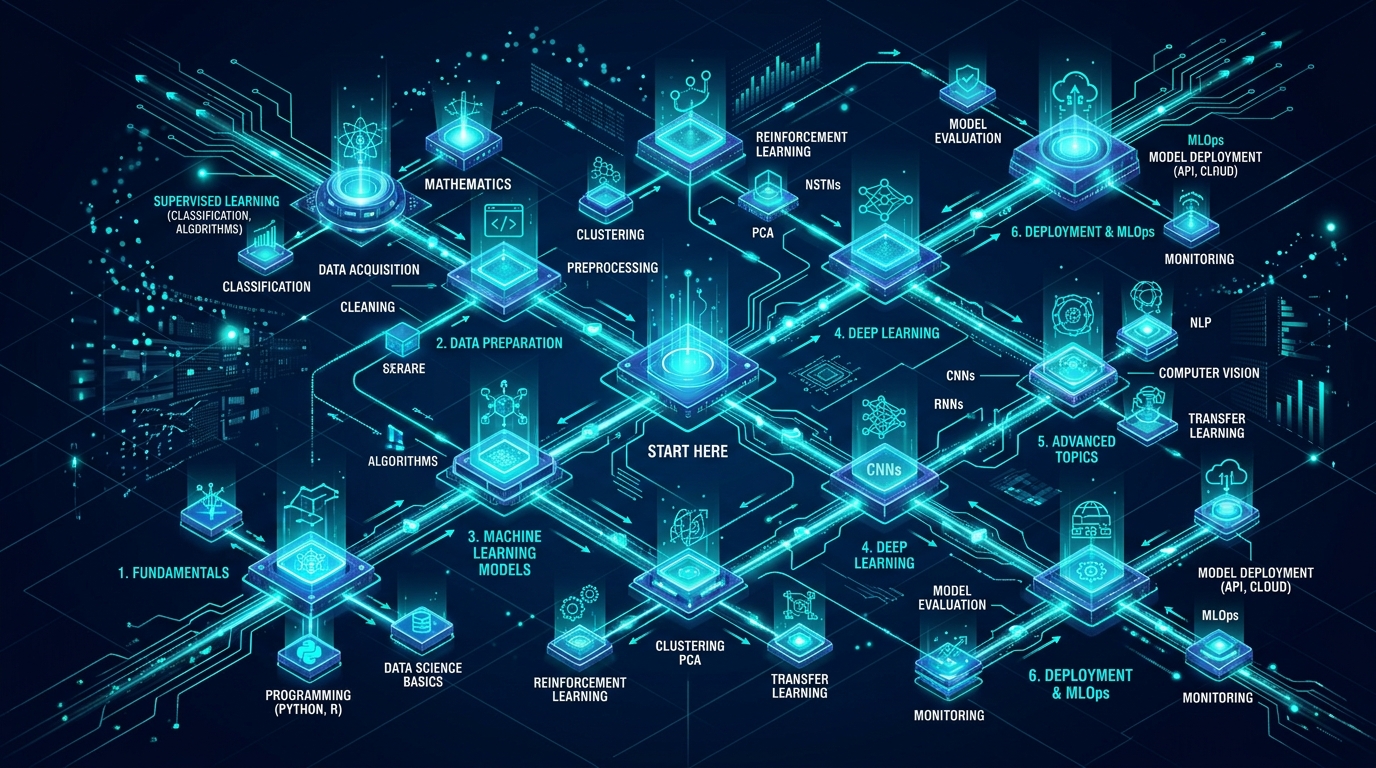
विषय सूची
Machine Learning आज technology industry में सबसे ज़्यादा demand में है। लेकिन इतने सारे content के बीच, क्या सीखें और किस order में — यही सबसे मुश्किल है।
यह roadmap वही problem solve करता है।
Phase 1: Foundation (महीना 1–2)
1.1 Python Programming
ML में सब कुछ Python में लिखा जाता है। इनमें comfortable होना ज़रूरी है:
- Data types: strings, integers, floats, booleans
- Data structures: lists, tuples, dictionaries, sets
- Control flow: if/else, for loops, while loops
- Functions और OOP basics
Goal: बिना Google किए confidently Python programs लिखना।
1.2 ML के लिए Mathematics
Linear Algebra:
- Vectors और matrices
- Matrix multiplication
- Dot products
Statistics & Probability:
- Mean, median, mode, standard deviation
- Probability basics
- Normal distribution
Calculus (Conceptual):
- Derivative क्या होता है
- Gradient descent — ML का core learning algorithm
Exam के लिए नहीं — concepts समझने के लिए सीखें।
Phase 2: Core ML Concepts (महीना 3)
ML Workflow
हर ML project इस pipeline को follow करता है:
Data Collection → Data Cleaning → Feature Engineering →
Model Selection → Training → Evaluation → Deployment
Data cleaning पर ज़्यादा ध्यान दें — real projects में 60–70% समय यहीं जाता है।
जानने लायक Algorithms
Regression (number predict करने के लिए):
- Linear Regression
- Ridge & Lasso Regression
Classification (category predict करने के लिए):
- Logistic Regression
- Decision Trees
- Random Forests
- Support Vector Machines (SVM)
Clustering (unlabelled data group करने के लिए):
- K-Means
Phase 3: Python ML Libraries (महीना 4)
NumPy
import numpy as np

arr = np.array([1, 2, 3, 4, 5])
print(arr.mean(), arr.std(), arr.max())

# Matrix multiplication (neural networks का आधार)
A = np.random.randn(3, 4)
B = np.random.randn(4, 5)
C = np.dot(A, B)  # Result shape: (3, 5)
Pandas
import pandas as pd

df = pd.read_csv('data.csv')
print(df.head())
print(df.describe())
print(df.isnull().sum())

# Missing values handle करें
df['age'].fillna(df['age'].mean(), inplace=True)
scikit-learn
from sklearn.model_selection import train_test_split
from sklearn.ensemble import RandomForestClassifier
from sklearn.metrics import accuracy_score

X_train, X_test, y_train, y_test = train_test_split(X, y, test_size=0.2)
model = RandomForestClassifier(n_estimators=100)
model.fit(X_train, y_train)

predictions = model.predict(X_test)
print(f"Accuracy: {accuracy_score(y_test, predictions):.2%}")
Phase 4: Projects (महीना 4–5)
इस order में projects बनाएं:
- Iris Flower Classification — classic beginner project
- Titanic Survival Prediction — data cleaning practice
- House Price Prediction — regression
- Customer Churn Prediction — business use case
- Sentiment Analysis — text classification
हर project को GitHub पर README के साथ publish करें।
Phase 5: Deep Learning (महीना 5–6)
Classical ML comfortable होने के बाद:
- Neural Networks — कैसे काम करते हैं
- Backpropagation — networks कैसे सीखते हैं
- CNN — image data के लिए
- RNN/LSTM — sequential data के लिए
TensorFlow/Keras (beginners के लिए friendly) या PyTorch (industry standard) use करें।
Roadmap Summary
महीना 1:   Python + Maths
महीना 2:   Core ML theory
महीना 3:   NumPy, Pandas, Matplotlib
महीना 4:   scikit-learn + 3 projects
महीना 5:   Deep Learning basics
महीना 6:   Specialisation + portfolio
महीना 7+:  Job applications
यह roadmap एक guide है, कोई strict rule नहीं। अपने background के हिसाब से speed adjust करें।
सबसे important बात — रुके नहीं, सीखते रहें।
टैग्स
💬 Comments coming soon — connect via the social links above to share your thoughts.