Generative AI Explained Simply for Students and Beginners
What is Generative AI, how does it work, and how can students use it? A clear, practical explanation without unnecessary jargon.

Table of Contents
You’ve heard of ChatGPT. You’ve probably used it. But how does it actually work?
And more importantly — as a student or aspiring developer — what do you need to know about Generative AI to build a career in it?
This article answers both questions clearly.
What Is Generative AI?
Generative AI refers to AI systems that can generate new content — text, images, code, audio, video — that didn’t exist before.
Traditional AI systems were mostly discriminative — they classified or predicted based on existing data. Generative AI creates.
Examples you already know:
- ChatGPT / Gemini — generate human-like text
- DALL-E / Midjourney / Stable Diffusion — generate images
- GitHub Copilot — generate code
- ElevenLabs — generate human-like voice
- Sora — generate videos
How Does Text Generation Actually Work?
At the core of text-generating AI are Large Language Models (LLMs).
LLMs are neural networks trained on enormous amounts of text data — billions of web pages, books, code repositories, research papers. Through this training, they learn:
- Grammar and writing patterns
- World knowledge and facts
- Reasoning patterns
- How conversations flow
When you type a prompt, the model doesn’t “understand” it in a human sense. It predicts what the most probable next word (token) is, given your prompt and all the text it was trained on.
Your prompt: "The capital of India is..."
LLM predicts: "New Delhi" (highest probability token)
It does this one token at a time, extremely fast, to generate an entire response.
The Transformer Architecture
Modern LLMs are built on the Transformer architecture — introduced by Google in 2017 in the paper “Attention Is All You Need.”
The key innovation is the attention mechanism, which allows the model to focus on relevant parts of the input when generating each output token.
Think of it like this: when translating “The animal didn’t cross the street because it was too tired,” the model needs to know that “it” refers to “animal” — not “street.” Attention handles this.
Key Terms You Should Know
| Term | What It Means |
|---|---|
| LLM | Large Language Model — the core AI behind text generators |
| Token | A chunk of text (roughly a word or word-piece) |
| Context window | How much text the model can “remember” at once |
| Prompt | The input you give to the model |
| Fine-tuning | Training a pre-built model on specific data |
| Embeddings | Numerical representations of text meaning |
| RAG | Retrieval Augmented Generation — connecting LLMs to external knowledge |
| Agent | An AI system that takes actions, not just generates text |
How to Use Generative AI as a Student
As a student or beginner developer, you can use Generative AI in three ways:
1. As a Learning Tool
- Ask ChatGPT or Gemini to explain concepts
- Get code explained line by line
- Generate practice exercises
- Summarise research papers
Prompt example:
"Explain gradient descent to me like I'm a high school student
who knows basic algebra but no calculus."
2. As a Productivity Tool
- Generate boilerplate code
- Get code reviews
- Draft README files
- Translate your notes
3. As a Career Skill
Learning to build with Generative AI is one of the most valuable skills right now. This means:
- Using APIs like OpenAI, Google Gemini, or Anthropic
- Building RAG systems
- Fine-tuning models for specific tasks
- Deploying AI-powered applications
A Simple Generative AI API Example
Here’s how to call an AI model programmatically:
import os
from openai import OpenAI

client = OpenAI(api_key=os.getenv("OPENAI_API_KEY"))

response = client.chat.completions.create(
    model="gpt-4o",
    messages=[
        {
            "role": "user",
            "content": "Explain machine learning in 3 sentences for a beginner."
        }
    ]
)

print(response.choices[0].message.content)
This is the foundation of every AI-powered application you see — chatbots, code assistants, content generators.
Is Generative AI Reliable?
Not always. LLMs have well-known limitations:
- Hallucinations — confidently stating false information
- Knowledge cutoffs — models don’t know events after their training date
- Bias — trained data reflects societal biases
- Context limitations — can’t process unlimited text at once
These are active research areas. As a developer, you need to build systems that handle these limitations gracefully.
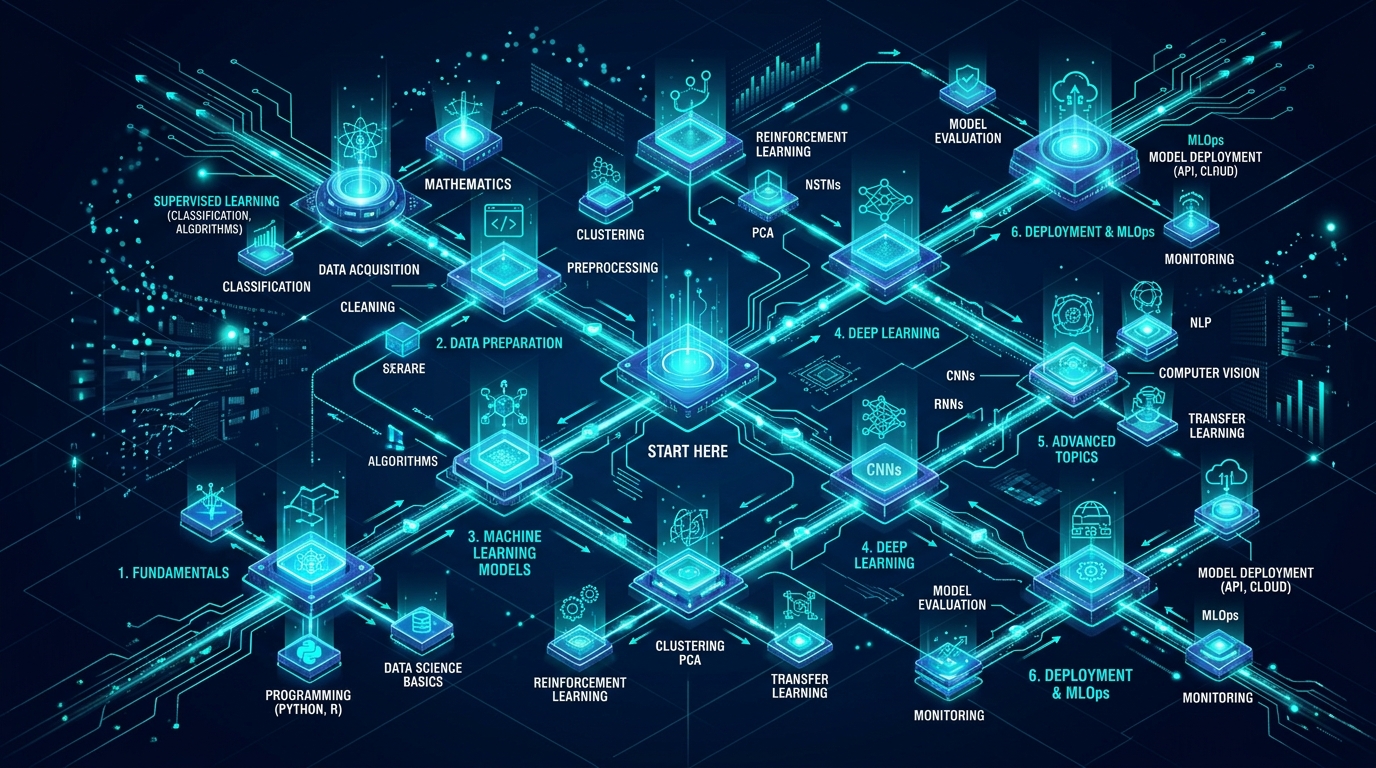
What Should You Learn to Work in Generative AI?
Start here:
- Python (essential)
- ML fundamentals (you need to understand what you’re building on)
- API integration (calling AI models programmatically)
- Prompt engineering (getting good outputs from models)
- LangChain or similar frameworks (building AI applications)
- Vector databases (for RAG systems)
The Opportunity Ahead
Generative AI is not just a trend. It’s a fundamental shift in how software is built. Every product, platform, and business is integrating AI capabilities.
Students who understand how to build with AI — not just use it — will have an enormous advantage in the job market.
Start learning. Start building.
Tags
💬 Comments coming soon — connect via the social links above to share your thoughts.