Machine Learning Roadmap for Beginners in 2026
A complete, structured roadmap for students and freshers who want to learn Machine Learning step by step — from zero to job-ready.

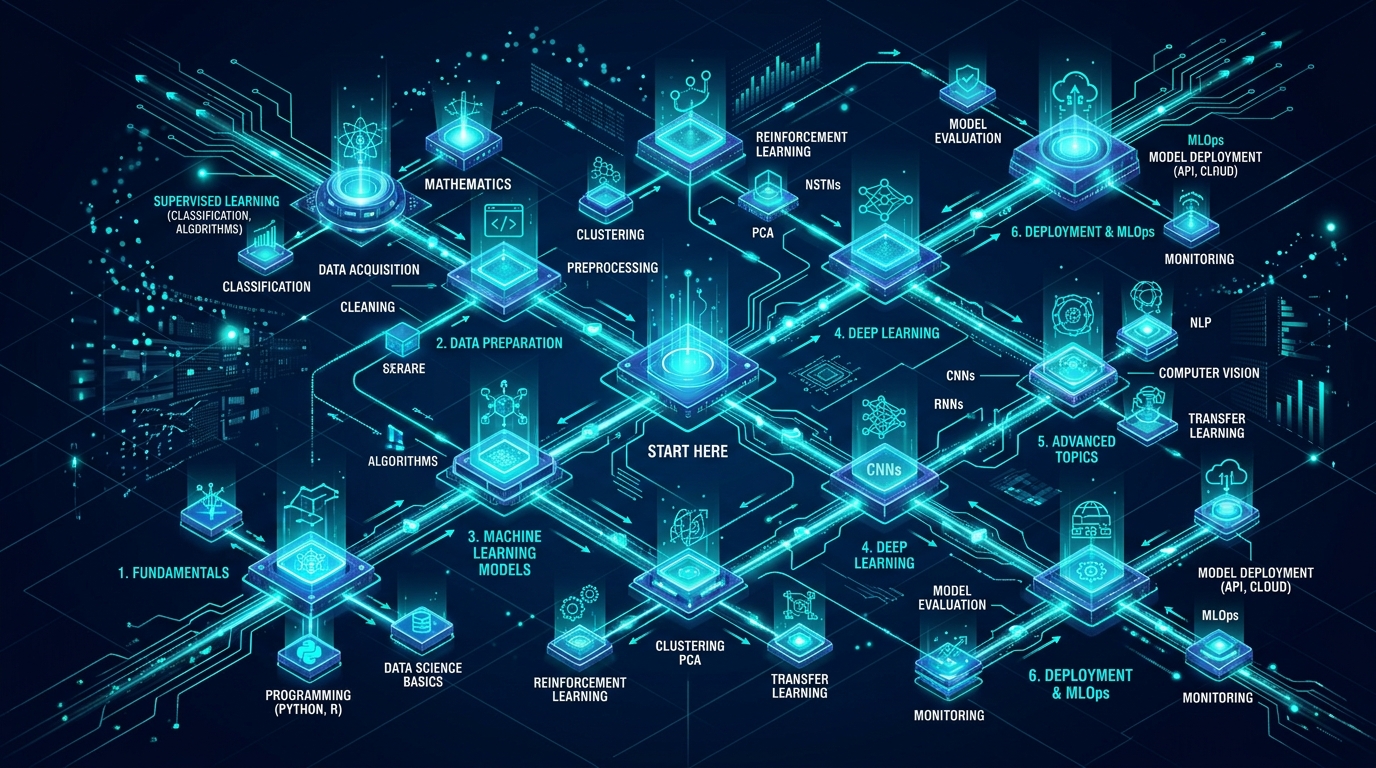
Table of Contents
Machine Learning is one of the most in-demand skills in the technology industry today. But with so much content available online, knowing what to learn and in what order is the hardest part.
This roadmap solves that problem. It’s structured for complete beginners with no prior ML experience — but it goes deep enough to get you job-ready.
Phase 1: Foundations (Months 1–2)
1.1 Python Programming
Everything in ML is written in Python. You need to be comfortable with:
- Data types: strings, integers, floats, booleans
- Data structures: lists, tuples, dictionaries, sets
- Control flow: if/else, for loops, while loops
- Functions and scope
- Object-Oriented Programming basics
- File I/O and working with JSON/CSV
Goal: Write Python programs confidently without constantly Googling basic syntax.
1.2 Mathematics for ML
Focus on these three areas:
Linear Algebra
- Scalars, vectors, matrices
- Matrix multiplication
- Dot products
- Transpose and inverse
Statistics & Probability
- Mean, median, mode, standard deviation
- Probability basics
- Normal distribution
- Correlation and covariance
Calculus (Conceptual)
- What a derivative means (rate of change)
- Gradient descent — the core learning algorithm in ML
- Chain rule (used in backpropagation)
You don’t need to solve calculus exam problems. You need to understand what gradient descent is doing when it trains a model.
Phase 2: Core ML Concepts (Month 3)
2.1 The ML Workflow
Every ML project follows this pipeline:
Data Collection → Data Cleaning → Feature Engineering →
Model Selection → Training → Evaluation → Deployment
Learn each step. Don’t skip data cleaning — in real projects, 60–70% of your time goes here.
2.2 Types of Learning
| Type | Description | Example |
|---|---|---|
| Supervised | Labelled training data | Email spam detection |
| Unsupervised | No labels, find patterns | Customer segmentation |
| Reinforcement | Learn from rewards/penalties | Game-playing AI |
| Semi-supervised | Mix of labelled + unlabelled | Medical image analysis |
2.3 Key Algorithms to Know
Regression (predicting numbers):
- Linear Regression
- Polynomial Regression
- Ridge & Lasso Regression
Classification (predicting categories):
- Logistic Regression
- Decision Trees
- Random Forests
- Support Vector Machines (SVM)
- K-Nearest Neighbours (KNN)
Clustering (grouping unlabelled data):
- K-Means
- DBSCAN
- Hierarchical Clustering
Dimensionality Reduction:
- Principal Component Analysis (PCA)
2.4 Model Evaluation
Learn these metrics — they tell you how well your model actually works:
from sklearn.metrics import (
    accuracy_score,      # Classification
    precision_score,     # Avoid false positives
    recall_score,        # Avoid false negatives
    f1_score,            # Balance of precision + recall
    mean_squared_error,  # Regression
    r2_score             # How well model fits data
)
Phase 3: Python ML Libraries (Month 4)
NumPy — Numerical Computing
import numpy as np

# Arrays
arr = np.array([1, 2, 3, 4, 5])
matrix = np.zeros((3, 3))

# Mathematical operations
print(arr.mean(), arr.std(), arr.max())
Pandas — Data Manipulation
import pandas as pd

# Load data
df = pd.read_csv('dataset.csv')

# Explore
print(df.head())
print(df.describe())
print(df.isnull().sum())

# Clean
df = df.dropna()
df['column'] = df['column'].fillna(df['column'].mean())
Matplotlib & Seaborn — Visualisation
import matplotlib.pyplot as plt
import seaborn as sns

# Distribution plot
sns.histplot(df['age'], kde=True)
plt.show()

# Correlation heatmap
sns.heatmap(df.corr(), annot=True)
plt.show()
scikit-learn — Machine Learning
from sklearn.model_selection import train_test_split
from sklearn.ensemble import RandomForestClassifier
from sklearn.metrics import accuracy_score

# Split data
X_train, X_test, y_train, y_test = train_test_split(
    X, y, test_size=0.2, random_state=42
)

# Train model
model = RandomForestClassifier(n_estimators=100)
model.fit(X_train, y_train)

# Evaluate
predictions = model.predict(X_test)
print(f"Accuracy: {accuracy_score(y_test, predictions):.2%}")
Phase 4: Projects (Month 4–5)
Build these projects in this order:
- Iris Flower Classification — classic beginner project
- Titanic Survival Prediction — data cleaning practice
- House Price Prediction — regression
- Customer Churn Prediction — business use case
- Sentiment Analysis — text classification
Each project should be published on GitHub with a clear README.
Phase 5: Deep Learning (Month 5–6)
Once you’re comfortable with classical ML, move to Deep Learning:
- Neural Networks — how they work (neurons, layers, weights)
- Backpropagation — how networks learn
- Activation Functions — ReLU, Sigmoid, Softmax
- CNN — for image data
- RNN / LSTM — for sequential data
Use TensorFlow/Keras (beginner-friendly) or PyTorch (industry standard).
Phase 6: Specialisation & Job Readiness (Month 6+)
Choose one specialisation based on interest:
- NLP — language models, transformers, text analysis
- Computer Vision — image recognition, object detection
- Generative AI — diffusion models, LLMs, fine-tuning
- MLOps — deploying and monitoring models in production
Essential Tools to Learn
| Tool | Purpose |
|---|---|
| Jupyter Notebook / VS Code | Writing and running code |
| Git + GitHub | Version control, portfolio |
| Kaggle | Datasets, competitions |
| Hugging Face | Pre-trained models |
| Google Colab | Free GPU for training |
Final Roadmap Overview
Month 1:   Python + Maths
Month 2:   Core ML theory
Month 3:   NumPy, Pandas, Matplotlib
Month 4:   scikit-learn + 3 projects
Month 5:   Deep Learning basics
Month 6:   Specialisation + portfolio
Month 7+:  Job applications
This roadmap is a guide, not a rigid rule. Move faster or slower depending on your background. The important thing is to keep building.
Good luck. You’ve got this.
Tags
💬 Comments coming soon — connect via the social links above to share your thoughts.