How to Start Learning AI as a Complete Beginner in 2026
A practical, jargon-free guide for students and freshers on how to begin their AI journey from scratch — no prior experience needed.

Table of Contents
Artificial Intelligence is no longer a topic reserved for PhDs and research labs. In 2026, learning AI is more accessible than ever — with free courses, open-source tools, and a massive online community ready to help you grow.
But where do you actually start?
That’s the question this guide answers. If you’re a student, a fresh graduate, or someone who has simply heard about AI and wants to understand it — this guide is written for you.
What Is Artificial Intelligence, Really?
Before you start learning, you need a clear mental model.
Artificial Intelligence (AI) is a broad field of computer science focused on building systems that can perform tasks that typically require human intelligence — things like:
- Understanding language
- Recognising images
- Making decisions
- Predicting outcomes
Machine Learning (ML) is a subset of AI. Instead of writing explicit rules, you train models on data — and they learn patterns on their own.
Deep Learning is a further subset of ML using neural networks with many layers.
Most practical AI work today involves Machine Learning or Deep Learning.
Why Should You Learn AI?
- AI is being applied across every industry — healthcare, education, finance, retail, manufacturing
- India’s AI talent demand is growing rapidly, with thousands of open positions
- AI skills command premium salaries — even entry-level
- Many AI tools are free and accessible to students
Prerequisites — What You Actually Need
You do not need:
- A mathematics PhD
- An expensive computer
- Years of programming experience
You do need:
- Basic comfort with a computer
- Willingness to learn Python (it’s beginner-friendly)
- Patience for the first two months
That’s honestly it. The learning curve feels steep at first, but flattens quickly once you start building things.
Step 1: Learn Python Basics (4–6 Weeks)
Python is the primary language of AI and Machine Learning. Almost every AI framework, tutorial, and job listing uses Python.
Start with:
# Your first Python program
print("Hello, AI World!")

# Variables and data types
name = "AI Career Lab"
year = 2026
is_learning = True

print(f"Welcome to {name} in {year}!")
Resources to start with:
- Python.org’s official beginner tutorial (free)
- freeCodeCamp Python course on YouTube (free)
- CS50P from Harvard (free on edX)
Focus on: variables, functions, loops, lists, dictionaries, and basic file handling. You don’t need to be a Python expert before touching AI.
Step 2: Learn the Mathematics You Actually Need
You will encounter three mathematical areas:
| Subject | What You Need | Why |
|---|---|---|
| Linear Algebra | Vectors, matrices, matrix multiplication | Neural networks are matrix operations |
| Statistics & Probability | Mean, median, distributions, probability | Models are fundamentally statistical |
| Calculus | Derivatives, gradient descent (conceptual) | How models learn from data |
Don’t let this list intimidate you. Start with a conceptual understanding — not formal proofs. Khan Academy and 3Blue1Brown (YouTube) are excellent free resources.
Step 3: Learn the Core AI/ML Concepts
Once you have Python basics and a feel for the math, start learning core ML concepts:
- Supervised Learning — training on labelled data
- Unsupervised Learning — finding patterns in unlabelled data
- Classification vs Regression — predicting categories vs predicting numbers
- Overfitting & Underfitting — understanding model quality
- Train/Validation/Test splits — how you evaluate models honestly
Tip: Don’t just read about these concepts. Use a free dataset (Kaggle has thousands) and run your own experiments. Code beats theory every time.
Step 4: Learn the Essential Python Libraries
These four libraries cover 80% of practical ML work:
import numpy as np          # Numerical computing
import pandas as pd         # Data manipulation
import matplotlib.pyplot as plt  # Visualisation
from sklearn import *       # Machine Learning algorithms
Learn them in this order. Pandas and NumPy come first, then Matplotlib, then scikit-learn.
Step 5: Build Your First Project
The fastest way to solidify your knowledge is to build something real. Start small:
- Iris flower classification — your first ML model
- House price prediction — your first regression model
- Spam email detector — text classification
Each of these takes 1–3 days to complete and teaches you the full ML pipeline: data → cleaning → training → evaluation.
What Comes Next?
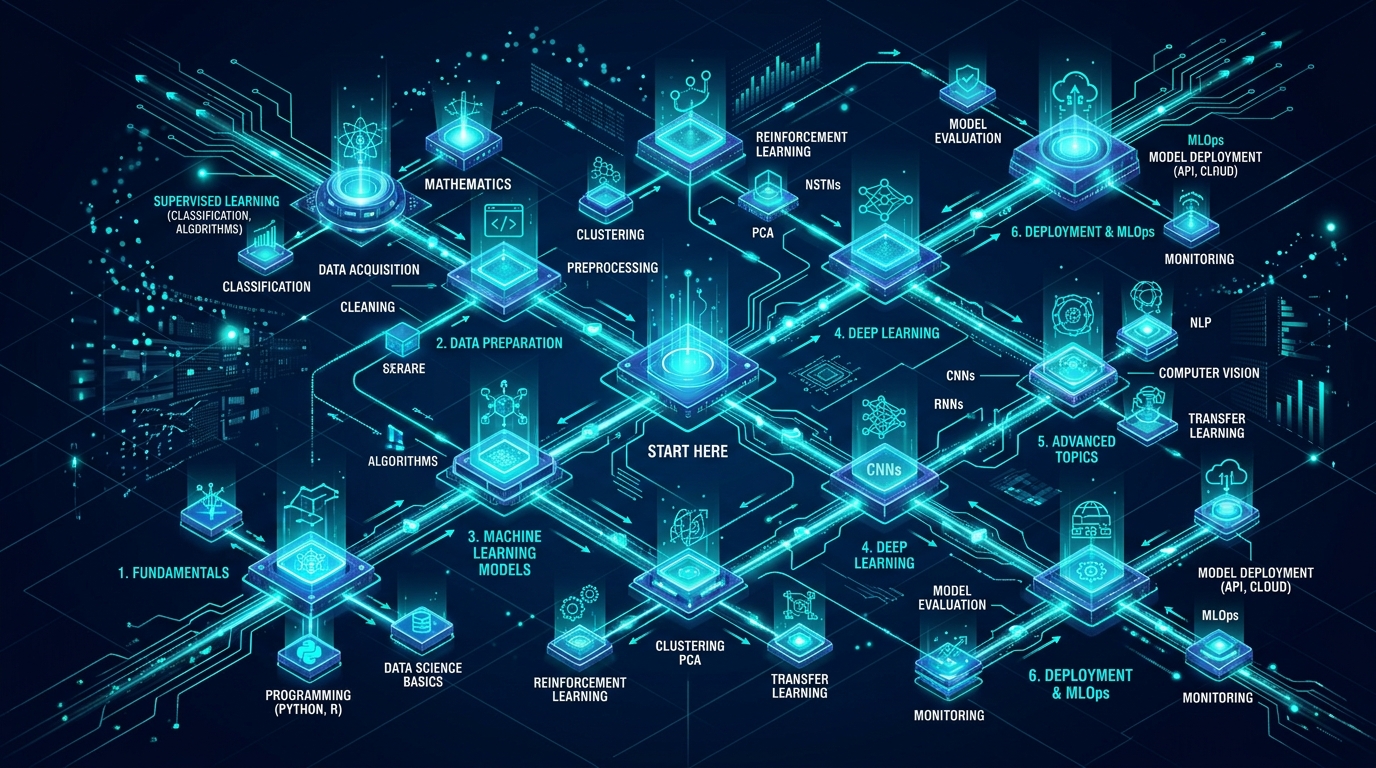
Once you’ve completed these five steps (expect 3–4 months), you’ll be ready for:
- Deep Learning with TensorFlow or PyTorch
- Natural Language Processing (NLP)
- Computer Vision
- Generative AI and Large Language Models (LLMs)
Recommended Learning Path Summary
Month 1–2:   Python basics + maths foundations
Month 3:     Core ML concepts + NumPy + Pandas
Month 4:     scikit-learn + your first 2–3 projects
Month 5–6:   Deep Learning intro + specialisation
Month 7+:    Portfolio projects + job preparation
Common Mistakes to Avoid
- Watching too many tutorials without coding — tutorial hell is real
- Waiting until you’re “ready” — start building before you feel ready
- Trying to learn everything at once — focus on one concept at a time
- Skipping projects — employers hire people who have built things
Final Words
Learning AI is one of the best career investments you can make as a student in 2026. The field is growing, the resources are free, and the community is welcoming.
Start with Python. Build a small project. Keep going.
The only prerequisite for learning AI is the decision to start.
Tags
💬 Comments coming soon — connect via the social links above to share your thoughts.